The Independent Path: UK & Switzerland — The Stablecoin Regulation Playbook Part 6
Written by

Chapter
Share article
Category
We’ve covered MiCA, the GENIUS Act, Asia-Pacific, and Latin America. Every market we’ve looked at either built its own framework from scratch or operates under MiCA’s umbrella.
Two significant markets did neither.
The UK left the EU before MiCA was finalized and chose to build its own regime. Switzerland has never been part of the EU and has regulated crypto under its own laws since 2019. Both watched MiCA take shape, studied it carefully, and decided to design something different. Not because they disagreed with the goals, but because their financial systems warranted a different approach.
Neither framework is fully live yet, but both are moving faster than most people realize.
The UK: A New Regime, Built From Scratch
The UK’s stablecoin story is inseparable from Brexit. Leaving the EU in 2020 meant losing access to MiCA’s passporting regime and gaining the freedom — and the obligation — to build something of its own. That process has been slower than many hoped, but it has accelerated sharply in 2026.
On 4 February 2026, the Financial Services and Markets Act 2000 (Cryptoassets) Regulations 2026 were enacted by Parliament, bringing cryptoassets within the FCA’s regulatory remit. The new regime is expected to come into force on 25 October 2027.
That’s the statutory foundation. The detailed rules are being built through an intensive series of FCA consultations running through 2026, with final rules expected before the regime goes live.
A two-tier structure
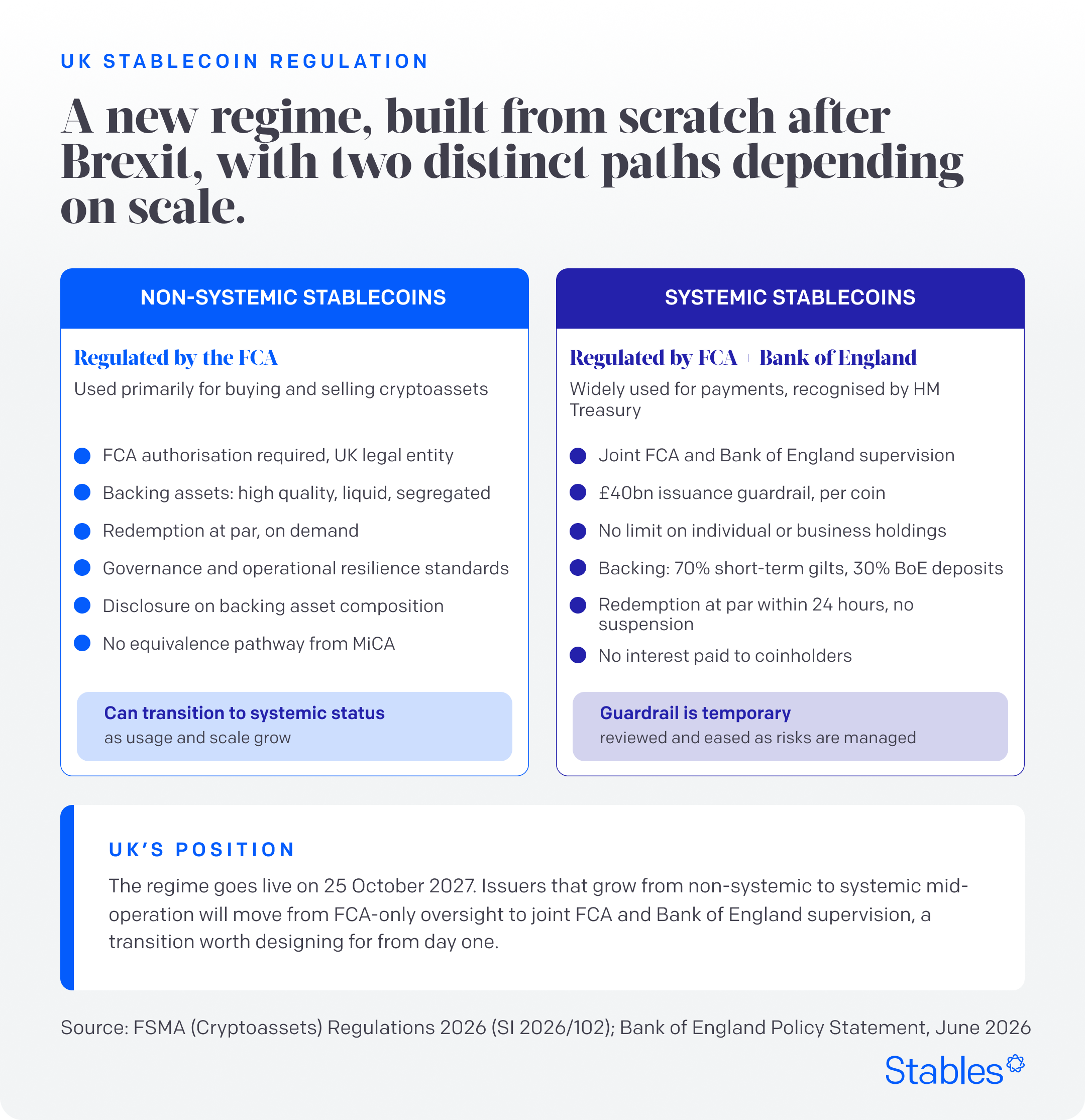
The UK separates stablecoins into two categories based on scale, each with a different regulator:
- Non-systemic stablecoins: the FCA published its consultation on stablecoin issuance and custody in 2025, with final rules expected in 2026.
- Systemic stablecoins: those that could pose risks to UK financial stability once recognized by HM Treasury.
The holding limits debate
One of the most contested elements of the UK framework was the Bank of England’s proposed limits on the holding of systemic stablecoins. The Bank had proposed capping individual holdings at £20,000 and business holdings at £10 million — limits significantly stricter than in either the US or the EU.
On 22 June 2026, the Bank published its policy statement and draft Code of Practice, scrapping that approach entirely. In its place, it introduced a temporary issuance guardrail: each systemic sterling stablecoin is capped at £40 billion in total circulation, with no restriction on how much any individual or business can hold. The Bank says it will review the guardrail regularly and expects to loosen or remove it once it is satisfied that risks to credit provision have been managed.
The shift moves the constraint from the user side to the supply side. Instead of limiting what any one person can hold, the Bank is limiting how large any single coin can grow. It’s a meaningful concession to industry, which had argued that per-wallet limits would be nearly impossible to enforce across exchanges and platforms, and would make stablecoins unworkable as a payment instrument. The Bank also loosened backing-asset rules alongside this change, allowing up to 70% of reserves to be held in short-term UK government debt, up from the previously proposed 60%.
For issuers, this is the clearest signal yet that the UK wants a workable, systemically stablecoin market, not just a theoretically compliant one. The £40 billion ceiling still caps the upside for any single coin, so it’s not an unlimited runway. Still, it removes what was widely seen as the biggest practical barrier to adoption. Feedback on the draft Code closes 22 September 2026, with the Bank targeting finalization by the end of the year.
The sandbox
The FCA selected four firms to test stablecoin products in its regulatory sandbox, with testing beginning in Q1 2026. The sandbox is designed both to let firms test products in a controlled environment and to inform the final rules going live in October 2027 directly.
For builders: the FCA authorization application window opens on 30 September 2026. If you plan to serve UK users and want to be live on day one of the new regime, that window is your planning horizon.
Switzerland: Pragmatic, Independent, Quietly Ahead
Switzerland’s approach to stablecoin regulation reflects a consistent feature of Swiss financial regulation more broadly: precision over speed, and a willingness to let firms operate under existing frameworks while better-fit rules are designed.
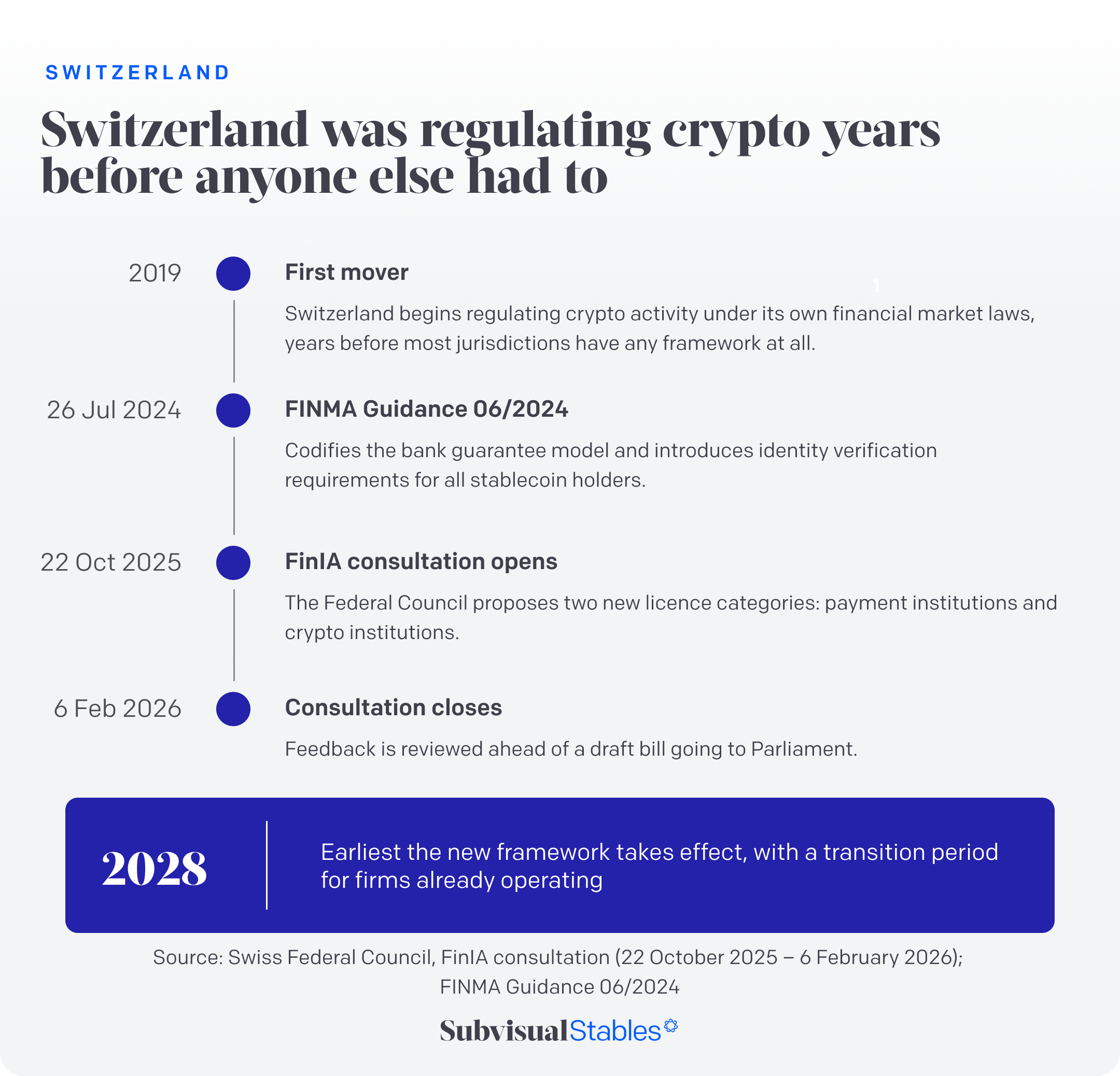
Switzerland has never been subject to MiCA. It has been regulating crypto activity under its own financial market laws since 2019, well before most jurisdictions had any framework at all. The question until recently was whether those existing rules were sufficient. The Swiss Federal Council concluded they weren’t, at least not for stablecoins specifically.
The existing framework: the bank guarantee model
Under FINMA’s current approach, stablecoin issuers whose tokens represent claims similar to deposits can avoid a full banking license by obtaining a guarantee from a regulated Swiss bank. FINMA Guidance 06/2024 codified the requirements for these guarantees and introduced identity verification obligations for all stablecoin holders. This model works. Several stablecoins operate in Switzerland under it today. But it relies heavily on a banking partner and has capacity constraints.
The new framework: two license categories
The Swiss Federal Council launched a public consultation on proposed amendments to the FinIA, introducing two new license categories: payment institutions, which replace the existing Fintech license and allow the issuance of stablecoins under enhanced prudential safeguards; and crypto institutions, designed for firms that safeguard or trade cryptoassets.
The payment institution license is the relevant one for stablecoin issuers. The issuance of regulated stablecoins will be reserved exclusively for payment institutions. Banks that want to issue stablecoins must establish a separate legal entity to do so. Key requirements are set out in Article 51l of the draft FinIA amendment: full backing in high-quality liquid assets, client funds segregated and bankruptcy-remote, a mandatory white paper published before issuance, and at least 60 days’ advance notice to FINMA before launching a new stablecoin.
What makes Switzerland different
Three things set the Swiss approach apart from every other framework in this series.
- The technology-neutral stance: FINMA has consistently held that regulatory outcomes should be the same regardless of the technology used. The question is what a product does, not how it is built. This has made Switzerland more hospitable to novel stablecoin structures than jurisdictions that rigidly apply existing financial product categories.
- The infrastructure: Switzerland has the most developed institutional crypto banking system in the world. SEBA Bank, Sygnum, and AMINA are all FINMA-regulated, crypto-native banks. A stablecoin issuer licensing as a payment institution in Switzerland has access to compliant banking partners as a structural feature of the market, not an obstacle to navigate.
- No EU passporting: like the UK, Switzerland’s regulatory approval does not extend to EU markets. A Swiss license does not grant EU passporting. A separate MiCA authorization is required for that. Builders targeting both Swiss and EU users need independent licensing tracks.
How the UK and Switzerland Compare
Both are independent of MiCA. Both are targeting a 2027–2028 go-live for their new frameworks. Both require local presence and offer no equivalence pathway to or from MiCA.
The differences are in approach:
- The UK framework is prescriptive: detailed FCA rules, a dual-regulator structure for systemic issuers, a defined authorization process with a specific application window.
- Switzerland’s framework is more principles-based: FINMA’s technology-neutral stance, the payment institution license as a clean pathway, and an institutional crypto infrastructure that already supports operations.

What This Means for Builders
Neither the UK nor Switzerland is a shortcut to European market access. That’s the most important thing to understand before deciding whether either belongs in your compliance stack.
- MiCA does not cover the UK or Switzerland. A MiCA-authorised issuer cannot serve UK or Swiss users without separate local authorization. These are independent licensing tracks, not extensions of each other.
- The UK application window is concrete. FCA authorization applications open on 30 September 2026. The October 2027 go-live gives roughly twelve months from application to operation. If you want to be live on day one, preparation starts now.
- Switzerland’s bank guarantee model works today. The new payment institution license doesn’t come into force until 2028. If you need to operate in Switzerland before then, the existing pathway under FINMA Guidance 06/2024 is available; it just requires a banking partner.
- Both jurisdictions require local substance. The UK requires a UK legal entity for any issuer serving UK consumers. Switzerland expects issuers to be locally established. Neither framework has a remote-issuer equivalence pathway.
What's Next
We’ve now covered six regulatory theatres: Europe, the US, Asia-Pacific, Latin America, the UK, and Switzerland. The frameworks are defined. The timelines are set.
The question that remains is the one builders actually have to answer: how do you actually build one?
Next, the capstone of this series: a builder’s guide to issuing a stablecoin. We’ll cover choosing a backing model, mapping your regulatory path before writing a line of code, getting reserves and custody right, and why compliance now has to live inside the smart contract itself, not get bolted on as paperwork once the token’s already live.