Latin America: Stablecoins as Infrastructure — The Stablecoin Regulation Playbook Part 5
Written by

Chapter
Share article
Category
We’ve covered MiCA, the GENIUS Act, and Asia-Pacific. Every market we’ve looked at so far has developed regulatory frameworks in response to the growth of stablecoins. In APAC, regulators moved early to get ahead of it. In Europe and the US, they moved to bring it under control.
Latin America is different.
Here, regulation is catching up to necessity. According to IMF research, Latin America has the highest stablecoin usage relative to GDP of any region in the world (7.7%). This is not because institutions demanded it, but because people needed it: access to dollars in high-inflation economies; cross-border remittances; and financial inclusion for populations that traditional banking has never adequately served.
The regulatory question in these countries isn’t “should we allow stablecoins?” It’s “how do we govern something that’s already essential?”
The answers vary dramatically by country, and they’re changing fast.
Why Stablecoins Took Root Here
Three forces drove stablecoin adoption across Latin America before any serious regulatory framework existed:
- Inflation. Argentina ended 2023 with the highest inflation since the hyperinflation crisis of the 1990s. When your local currency loses value faster than you can spend it, a dollar-pegged stablecoin is more of a survival mechanism than a financial product. The same dynamic plays out in Venezuela, where citizens continue to use stablecoins as protection against the collapse of the bolívar.
- Remittances. Mexico’s families received over $60 billion in remittances in 2023, and crypto is increasingly part of those flows. Stablecoins cut the fees and friction that have historically extracted a tax from every dollar sent home.
- Financial exclusion. Fewer than 70% of Mexican adults hold a bank account. Opening one is often complex, slow, and gatekept. Downloading an app and self-custodying a stablecoin is not. For millions of people, stablecoins were the on-ramp to financial services that banks never provided.
These are the primary reasons stablecoins spread across the region—and why regulators are now racing to govern a payment system that already exists at scale.
Brazil: The Region's Institutional Hub
Brazil is the biggest stablecoin market in Latin America, and it’s the one moving the fastest on regulation (though not always in the direction builders expect).
Brazil received an estimated $318.8 billion in crypto value in 2024, ranking 5th on the 2025 Global Crypto Adoption Index. In early 2025, BCB chief Gabriel Galipolo stated that around 90% of that volume is in the form of stablecoin movements. Those numbers forced the regulator’s hand.
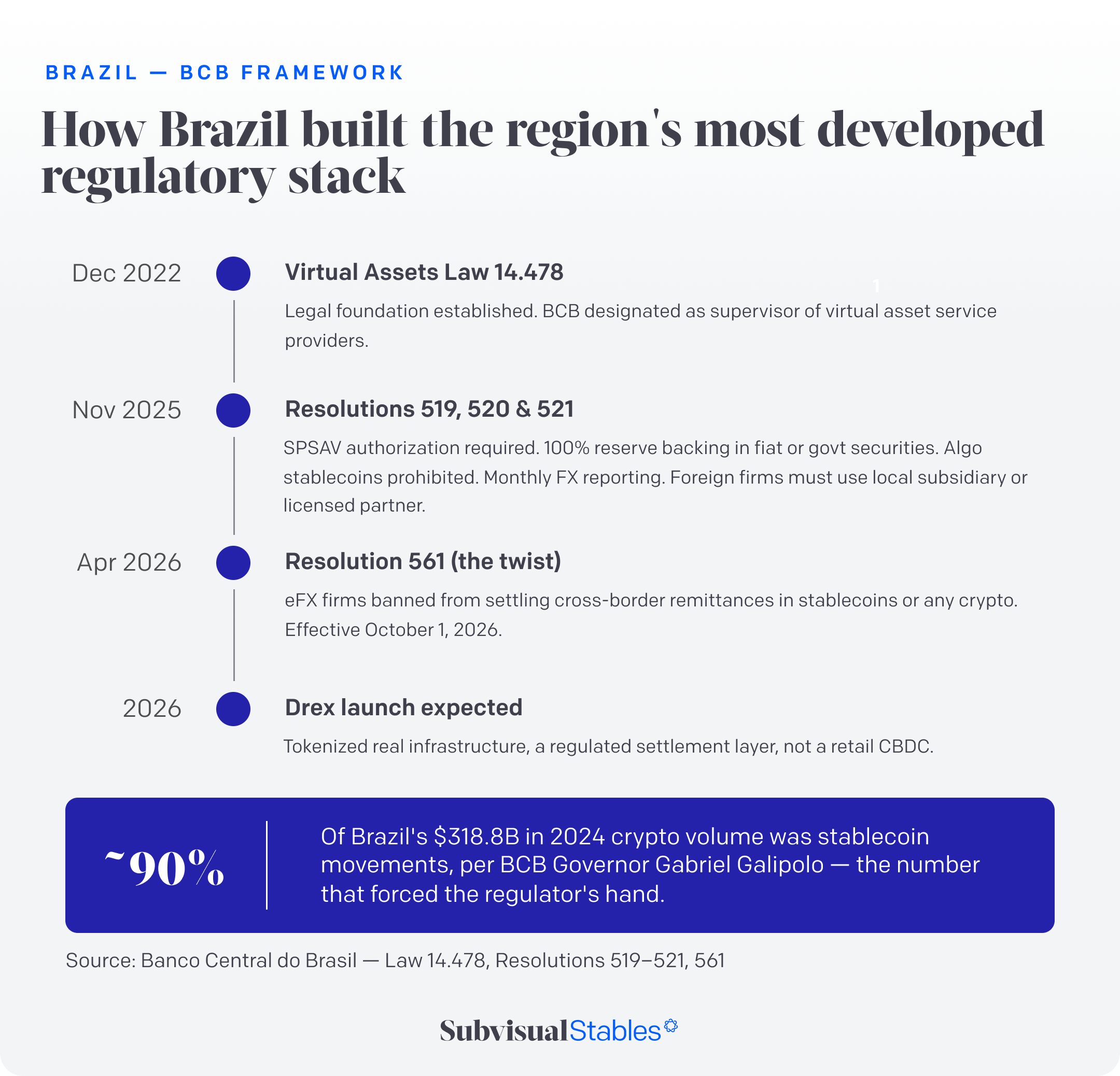
The BCB’s reasoning behind Resolution 561 is strategic. The central bank is developing Drex as the regulated settlement layer for Brazilian digital finance and allowing dollar-denominated private stablecoins to consolidate as the default cross-border payment rail, thereby fragmenting the national payment system before Drex has a chance to establish itself.
This is not a ban on stablecoins. Crypto trading, holding, and transfer through authorized VASPs remain fully legal. But the back-end settlement rail that companies like Nomad and Braza Bank had built stablecoin settlement into is closing.
For builders: the path to operating legally in Brazil is clearly defined. But if your product depends on dollar-stablecoin cross-border settlement through regulated entities, the compliance landscape shifted materially in May 2026.
Argentina: The De Facto Dollarization
Argentina’s stablecoin story runs in the opposite direction from Brazil’s. While Brazil is building guardrails around an existing market, Argentina is leaning into stablecoin adoption as a feature rather than a risk to manage.
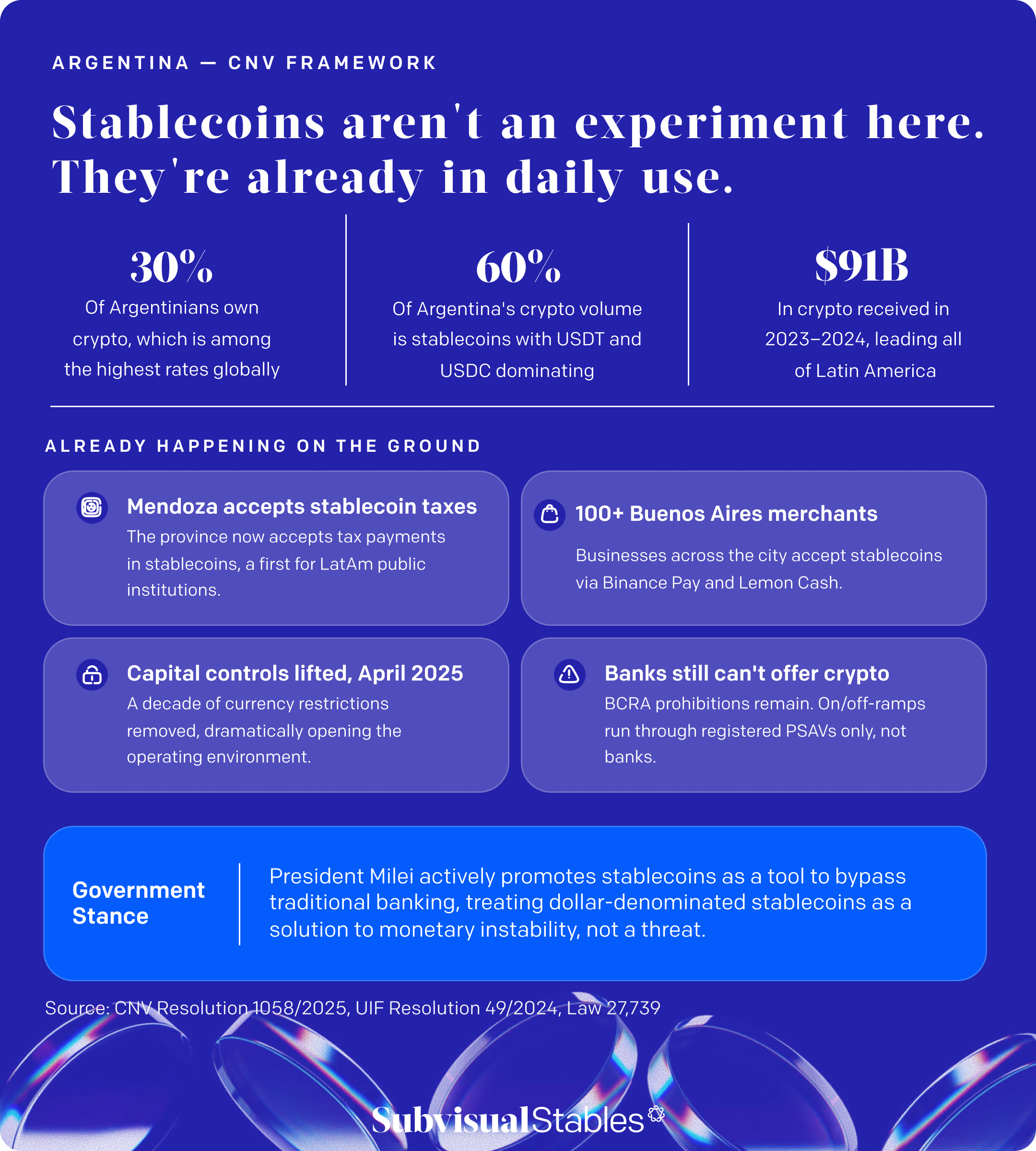
Argentina passed Law 27,739 in March 2024, establishing the VASP framework and granting the CNV authority to oversee crypto companies. CNV Resolution 1058/2025 operationalized this by establishing the PSAV registration registry for all virtual asset service providers exceeding the monthly volume threshold.
That’s a clear registration pathway, a government that treats stablecoins as a solution rather than a threat, and a population that was already using them before any framework existed. For builders, that combination is rare.
Mexico: The Remittance Giant, Still Cautious
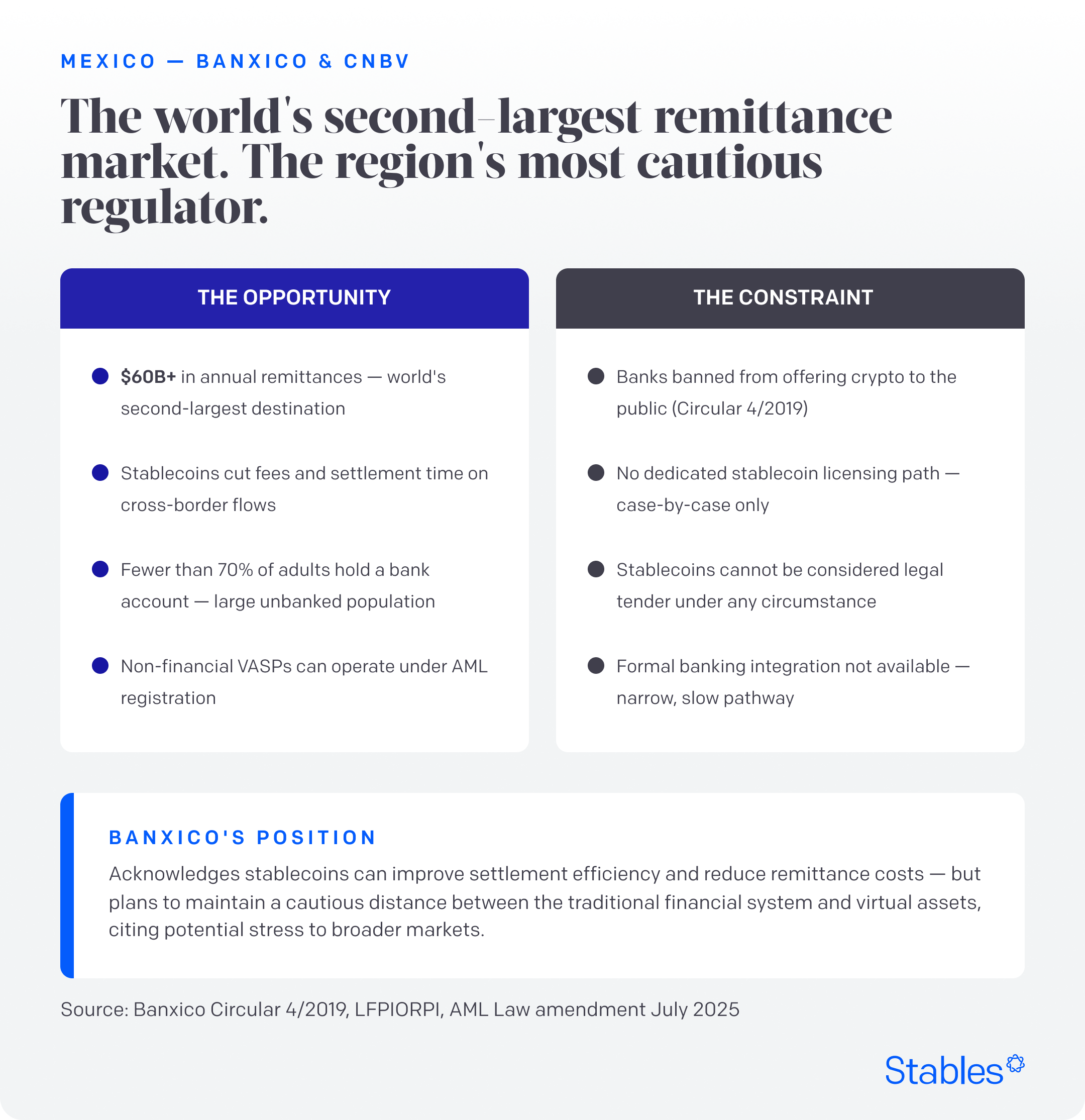
A July 2025 amendment to the Anti-Money Laundering Law introduced new reporting thresholds and Travel Rule obligations for VASPs — movement, but primarily on the surveillance side rather than the licensing side. The formal pathway for a stablecoin issuer to integrate with the Mexican financial system remains narrow, case-by-case, and slow.
The playbook for operating in Mexico today is non-financial VASP status under AML obligations, not a banking or payments license.
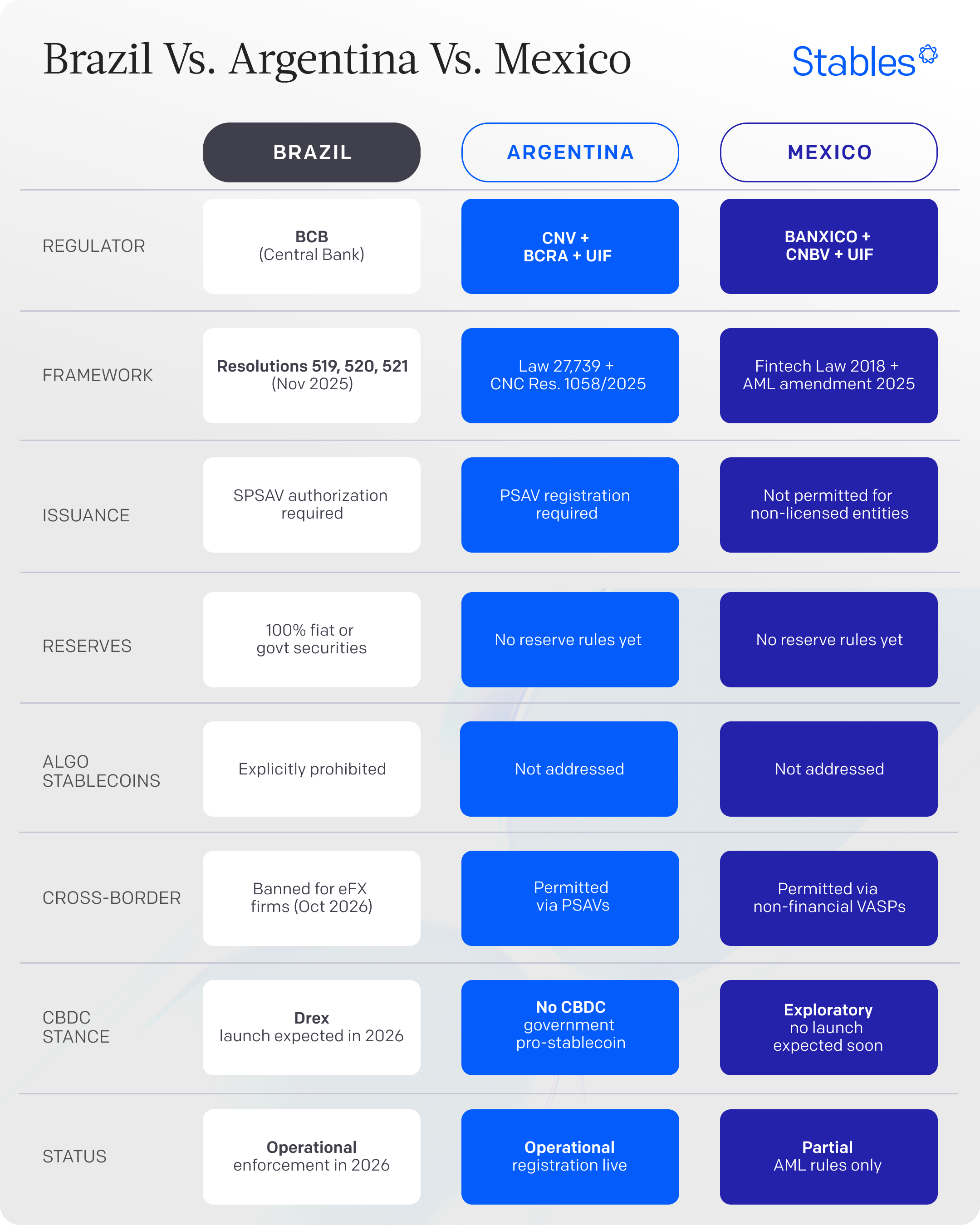
How the Three Markets Compare
The contrast among Brazil, Argentina, and Mexico captures the full spectrum of how LatAm approaches stablecoin regulation.
What This Means for Builders
Latin America is not a single regulatory market. It’s three meaningfully different regimes, and the contrast matters operationally.
- Local presence is expected everywhere. Brazil requires it explicitly through the SPSAV process. Argentina’s CNV registration is built around local filing. Mexico’s AML enforcement applies to anyone serving Mexican residents, regardless of location.
- AML is the floor, not the ceiling. All three markets have substantive KYC, transaction monitoring, and reporting requirements. Travel rule obligations are live in Brazil and Mexico, operational in Argentina. These are day-one requirements, not eventual ones.
- Distribution models differ by country. In Argentina, on- and off-ramps must run through registered PSAVs, not banks. In Brazil, regulated cross-border settlement in stablecoins through eFX firms is closing. In Mexico, the formal banking channel isn’t available. Your distribution architecture has to account for these constraints from the start.
- The regulatory picture is moving. Brazil’s Resolution 561 was published six days ago. Argentina’s bank restrictions may lift in 2026. Mexico’s AML amendments are less than a year old. Building for Latin America means building compliance systems that can absorb regulatory change, because change is the baseline assumption here.
What's Next
Latin America shows what stablecoin adoption looks like when it happens organically. Driven by necessity, not institutional demand. The regulatory question isn’t whether stablecoins belong here, but how to govern something that’s already load-bearing infrastructure.
We’ve now covered four regulatory theatres: Europe, the US, Asia-Pacific, and Latin America. Next, we turn to the jurisdictions that watched MiCA and the GENIUS Act take shape, and decided to do something different: the UK post-Brexit, Switzerland, and the middle-ground frameworks quietly building some of the most builder-friendly regimes in the world.