The History of MiCA: From Libra to Europe’s Crypto Rulebook
Written by

Chapter
- Introduction
- The MiCA timeline at a glance
- 2019: the year a social network scared the finance ministers
- 2020: the Commission's answer arrives as a package
- 2021 and 2022: the fights that shaped the final text
- 1 July 2026: the last door closes
- The question the history doesn't answer
- Frequently asked questions
Share article
Category
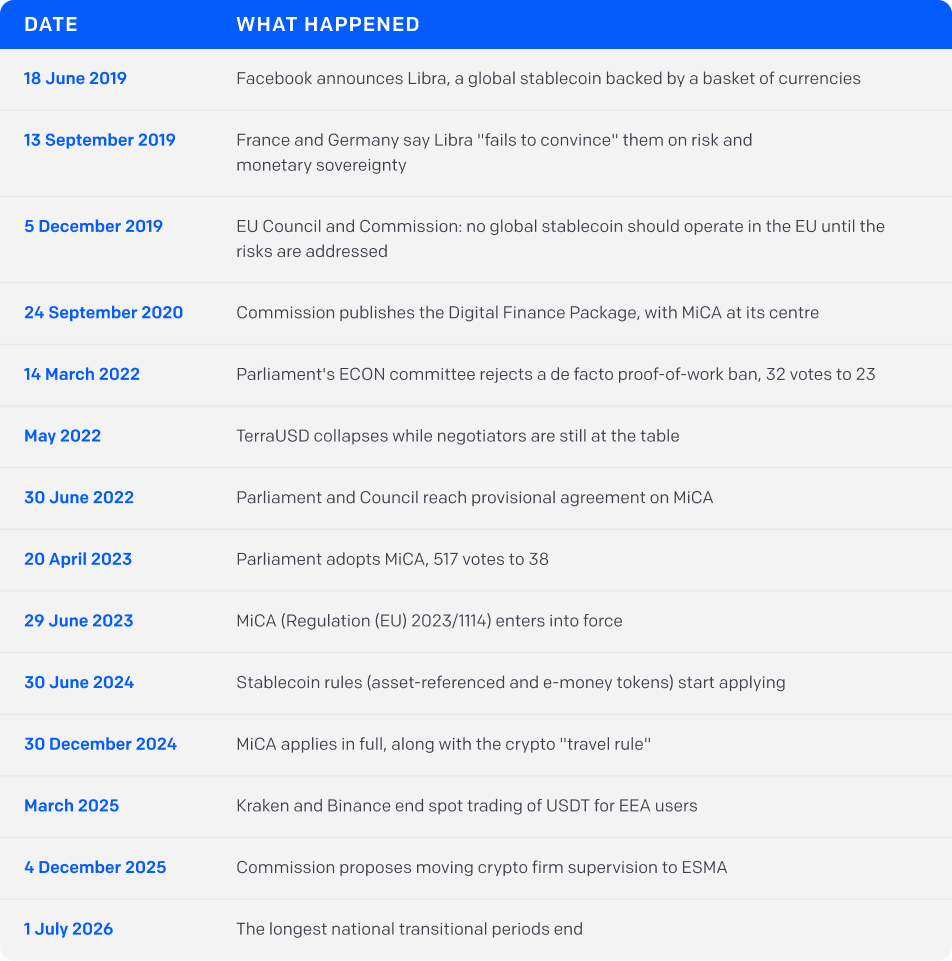
The short version: MiCA, the EU’s Markets in Crypto-Assets Regulation, exists because of Facebook. When Libra was announced in June 2019, European finance ministers decided that a global stablecoin was something they wanted to license before it existed, not after. The Commission proposed MiCA in September 2020. It was agreed in June 2022, became law in June 2023, started applying to stablecoins on 30 June 2024 and to everyone else on 30 December 2024. On 1 July 2026, the last transitional period closed. Seven years from start to finish.
Most writing about MiCA tells you what the rules say. Our own Stablecoin Regulation Playbook does exactly that, article by article. This piece is about something else: how the rulebook got written, what scared people into writing it, and which arguments were won and lost along the way. A lot of what MiCA looks like today only makes sense once you know the order things happened in.
The MiCA timeline at a glance
2019: the year a social network scared the finance ministers
Libra was the reason MiCA was written. Before June 2019, crypto in Europe was mostly an anti-money-laundering problem, handled by registering exchanges under the Fifth Anti-Money Laundering Directive. Libra turned it into a monetary sovereignty problem. A company with more than two billion users was proposing to issue its own money, backed by a basket of currencies, and run it from Geneva.
The reaction was fast and unusually blunt. On 13 September 2019, after a meeting of eurozone finance ministers in Helsinki, Bruno Le Maire and Olaf Scholz issued a joint statement saying Libra “fails to convince” them that its risks could be handled. Le Maire went further in Paris the same day: “We cannot authorize the development of Libra on European soil.” The same statement asked European central banks to “accelerate work” on a public digital currency, which is worth remembering. The digital euro and MiCA started in the same week, as answers to the same fear.
By December the position was official. On 5 December 2019 the EU Council and the Commission said, jointly, that no global stablecoin arrangement should begin operating in the EU until its legal, regulatory and oversight risks had been “adequately identified and addressed”. In practice that meant: we’ll write the rules first.
Libra never launched. It was renamed Diem in December 2020, and on 31 January 2022 the Diem Association sold its technology to Silvergate for about $182 million. By then, the rulebook it had provoked was already halfway through Parliament.
2020: the Commission's answer arrives as a package
MiCA was proposed on 24 September 2020 as part of the Commission’s Digital Finance Package. It came with two siblings: the DLT Pilot Regime, a sandbox for trading and settling tokenized securities, and DORA, the Digital Operational Resilience Act. The package’s logic was simple. Anything that already counted as a financial instrument stayed under existing law. Everything else that lived on a ledger would get its own regime.
The proposal split crypto-assets into three buckets: asset-referenced tokens (ARTs, the Libra shape: backed by a basket), e-money tokens (EMTs, pegged to a single currency) and everything else. The stablecoin buckets got the heaviest rules by far. A Libra-shaped token was always the point.
The other big idea was the passport. A crypto-asset service provider (CASP) authorized in one member state could serve customers in all of them. That was the trade on offer: tougher rules than almost anywhere, in exchange for one licence covering a market of around 450 million people.
2021 and 2022: the fights that shaped the final text
The two years of negotiation were mostly about three things: energy, stablecoins and timing.
The energy fight came first, and it came close. Some MEPs wanted MiCA to restrict “environmentally unsustainable” consensus mechanisms, which would have hit Bitcoin’s proof of work. The vote was postponed in late February 2022 after the rapporteur, Stefan Berger, warned that the text could be “misinterpreted as a de facto Bitcoin ban”. When the ECON committee finally voted on 14 March 2022, the restriction was rejected 32 to 23, with six abstentions. MiCA ended up with sustainability disclosures instead of a ban.
The stablecoin fight was quieter and lasted longer. National governments, the ECB and the European Banking Authority all wanted large stablecoins treated as a possible threat to monetary policy and payment systems. That is where MiCA’s “significant” token category comes from, with extra supervision from the EBA, and where the limits on how widely a stablecoin pegged to a non-EU currency can be used for everyday payments come from too.
Then events weighed in. TerraUSD, an algorithmic dollar stablecoin with no real reserves, lost its peg in May 2022 and took tens of billions of dollars of value with it. Negotiators reached their provisional agreement on 30 June, a few weeks later. The final text has no room for a token like that: stablecoins under MiCA need reserves, a redemption right at par, and an issuer the supervisor can find.
FTX collapsed that November, after the deal was done but before the final vote. Parliament did not reopen the text. On 20 April 2023 it adopted MiCA by 517 votes to 38, and on the same day passed the Transfer of Funds Regulation, which brought the “travel rule” (sender and recipient information travels with the transfer) to crypto.
MiCA entered into force on 29 June 2023, but it switched on in two stages. The stablecoin titles applied first, from 30 June 2024. Everything else, including authorization for exchanges, brokers and custodians, applied from 30 December 2024.
The stablecoin-first order was a choice, and it shows what the legislators were most worried about. It also produced the first real test of the regime. On 1 July 2024, the day after the rules applied, Circle announced it had become the first global stablecoin issuer to comply with MiCA, issuing both USDC and EURC in the EU through a French electronic money institution license from the ACPR.
Tether, the issuer of the largest stablecoin in the world, went the other way and did not seek authorization. That set up the first collision between the rulebook and the market.
2025 was the year exchanges had to choose which stablecoins European users could trade. Kraken moved USDT to sell-only for EEA customers in February and halted spot trading on 24 March. Binance ended spot trading pairs with USDT for EEA users on 31 March 2025, while still letting users hold and withdraw it. ESMA clarified that custody and transfer of non-compliant stablecoins weren’t banned outright. Offering them to the European public was a different matter.
Meanwhile, the transitional clock was ticking unevenly. Article 143 of MiCA let firms already operating under national law keep going while they applied, for up to 18 months, but each member state chose its own length. The Netherlands, Poland, Finland and a few others went for six months, which ended on 30 June 2025. Germany, Ireland, Spain and others chose twelve, ending on 30 December 2025. The rest took the full eighteen.
Two debates from late 2025 are still open. In September, the European Systemic Risk Board recommended that the Commission treat “multi-issuer” schemes, where the same stablecoin is issued both inside and outside the EU, as not permitted under MiCA. The Commission hasn’t agreed: its 2026 review consultation says MiCA doesn’t currently prohibit them. In their September 2026 responses, the ECB asked for that to be clarified and the EBA asked for a dedicated regime. And on 4 December 2025, the Commission proposed a Market Integration and Supervision Package that would move CASP authorization and supervision from national authorities to ESMA. Neither has been settled. The ESMA proposal is expected to be negotiated into 2027 at least.
1 July 2026: the last door closes
On 1 July 2026 the longest transitional periods ended, and MiCA became the only legal way to provide crypto services anywhere in the EU. Any firm still relying on an old national registration had to hold a full authorization or stop serving European customers. This was the moment the rulebook stopped being a project and became the market structure.
That is where this history ends, because it is where a different question starts.
The question the history doesn't answer
Seven years of work produced the most complete crypto rulebook any major jurisdiction has. Europe finished it two years before the United States passed the GENIUS Act, and while the UK was still consulting.
But a rulebook is a means. It was written to make a market safe, legal and, for its authors, European. Whether it has done the last part is a question the legislative record can’t answer. You have to look at what is actually moving on the rails: who got authorized and where, what got issued, in which currency, and who is holding it.
Frequently asked questions
Why was MiCA created?
MiCA was created mainly in response to Facebook’s Libra project, announced in June 2019. EU governments saw a global, privately issued stablecoin as a risk to consumers, financial stability and monetary sovereignty. In December 2019 the Council and Commission agreed that no global stablecoin should operate in the EU until rules existed, and the Commission proposed MiCA in September 2020.
When did MiCA come into force?
MiCA entered into force on 29 June 2023, after its publication in the Official Journal as Regulation (EU) 2023/1114. Its rules applied in stages: stablecoin provisions from 30 June 2024, and the rest of the regulation, including licensing for crypto-asset service providers, from 30 December 2024.
When did the MiCA transitional period end?
It depended on the member state. MiCA allowed up to 18 months for firms already operating under national law. Several countries chose six months (ending 30 June 2025), others twelve (ending 30 December 2025), and the rest the full eighteen, which ended on 1 July 2026. Since that date, every crypto-asset service provider in the EU needs a MiCA authorization.
Who wrote MiCA?
The European Commission drafted the proposal, presented in September 2020 by Executive Vice-President Valdis Dombrovskis. In the European Parliament, the lead negotiator (rapporteur) was German MEP Stefan Berger. The final text was agreed between Parliament and the Council of the EU in June 2022.
Did MiCA ban Bitcoin?
No. In March 2022, Parliament’s economic affairs committee voted 32 to 23 against an amendment that would have restricted proof-of-work crypto-assets such as Bitcoin. MiCA instead requires disclosures about the environmental impact of consensus mechanisms.
Is MiCA finished?
The original regulation is fully in force, but it is still being adjusted. Open questions in late 2026 include whether multi-issuer stablecoins should be permitted, and a Commission proposal from December 2025 to move supervision of crypto-asset service providers from national authorities to ESMA.
Building for a MiCA market? We’ve built stablecoin infrastructure from scratch, and we run Stables for teams who’d rather not build the rails themselves. Let’s talk.