How to Issue a Stablecoin: A Builder’s Guide (2026)
Written by

Chapter
- Introduction
- Step 1: Choose the model (and know which one is effectively off the table)
- Step 2: Map the regulatory path before you write a line of code
- Step 3: Get reserves and custody right — they are the product
- Step 4: Design the smart-contract system, not "a token"
- Step 5: Make compliance programmable — bake it into the contracts
- Step 6: Wire up oracles, monitoring, and reserve attestation
- Step 7: Redemption and launch operations
- Things to not underestimate
- Frequently asked questions
Share article
Category
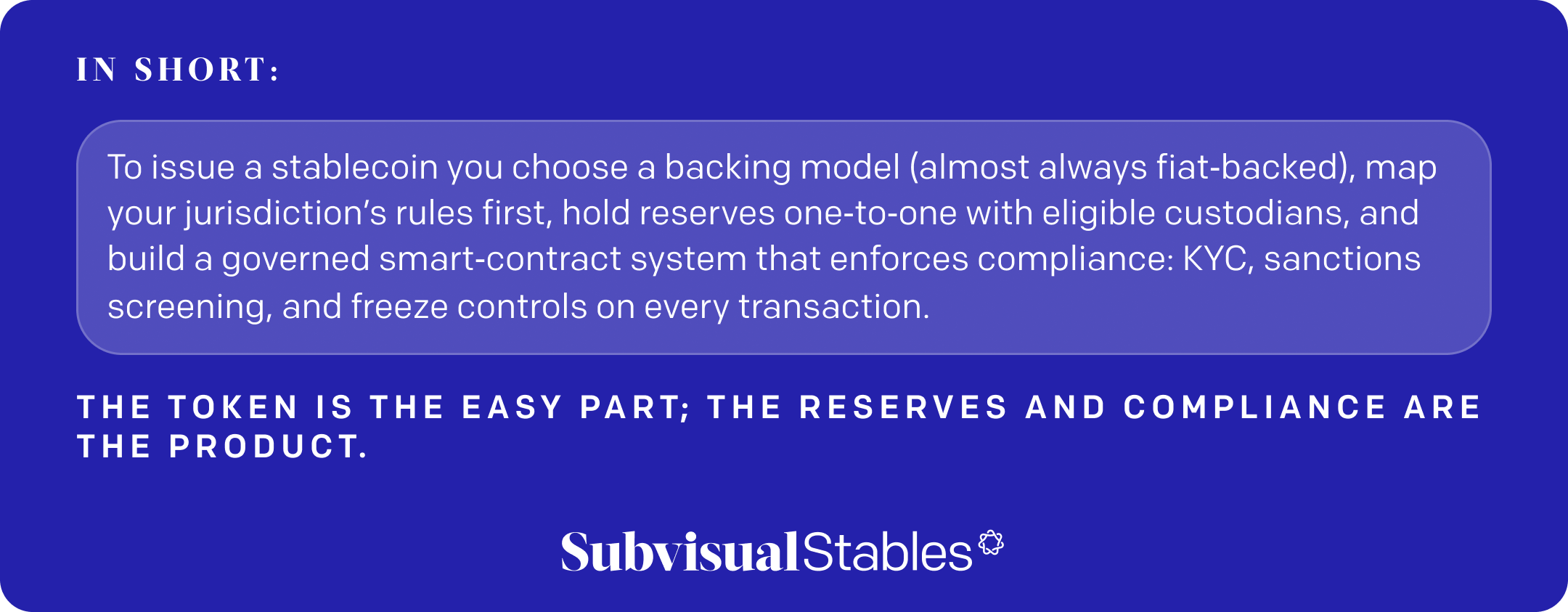
Issuing a stablecoin means putting a token into the world that’s redeemable, one-to-one, for something stable, usually a dollar, and then being able to prove, on demand and to a regulator, that the backing is really there. Minting the token is as easy as pie. With the help of Claude Code, it’s an afternoon. The hard part is everything that makes people, and supervisors, trust it: the reserves, the custody, the redemption guarantee, and the compliance logic, most of which now has to live inside the code itself.
That’s the thing we want you to take from this guide. In 2026, issuing a stablecoin is an engineering problem and a regulatory problem at the same time, and you can’t sequence them. The teams that treat compliance as paperwork to bolt on at the end ship twice. The ones that treat it as an engineering constraint for smart contracts to enforce ship once.
We’ve spent a lot of time on both sides of this, including the regulatory homework: if you want the deep version of the rules, our Stablecoin Regulation Playbook series goes jurisdiction by jurisdiction.
You’ve checked it? Good. Let’s get to it.
Step 1: Choose the model (and know which one is effectively off the table)
There are three classic designs, and in 2026 only two are worth your time.
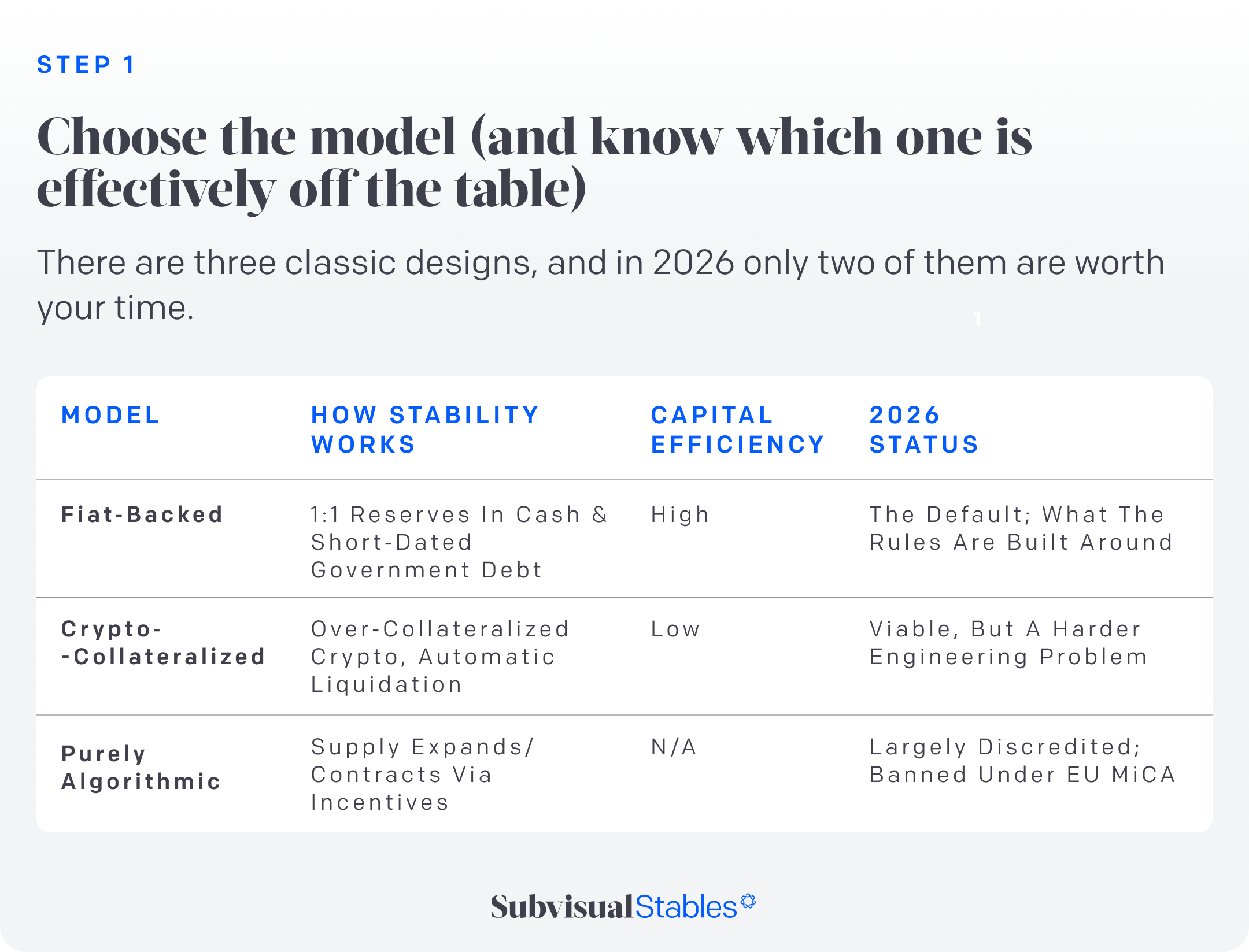
For the rest of this guide, we’ll assume the fiat-backed model because it’s the common case and the one the rules are written for.
Step 2: Map the regulatory path before you write a line of code
This is the step teams most want to skip, because it’s boring.
First piece of advice: don’t.
This is what most determines your architecture. Where you’re allowed to issue, how the coin is classified, and what you must enforce all change the contracts you’ll write.
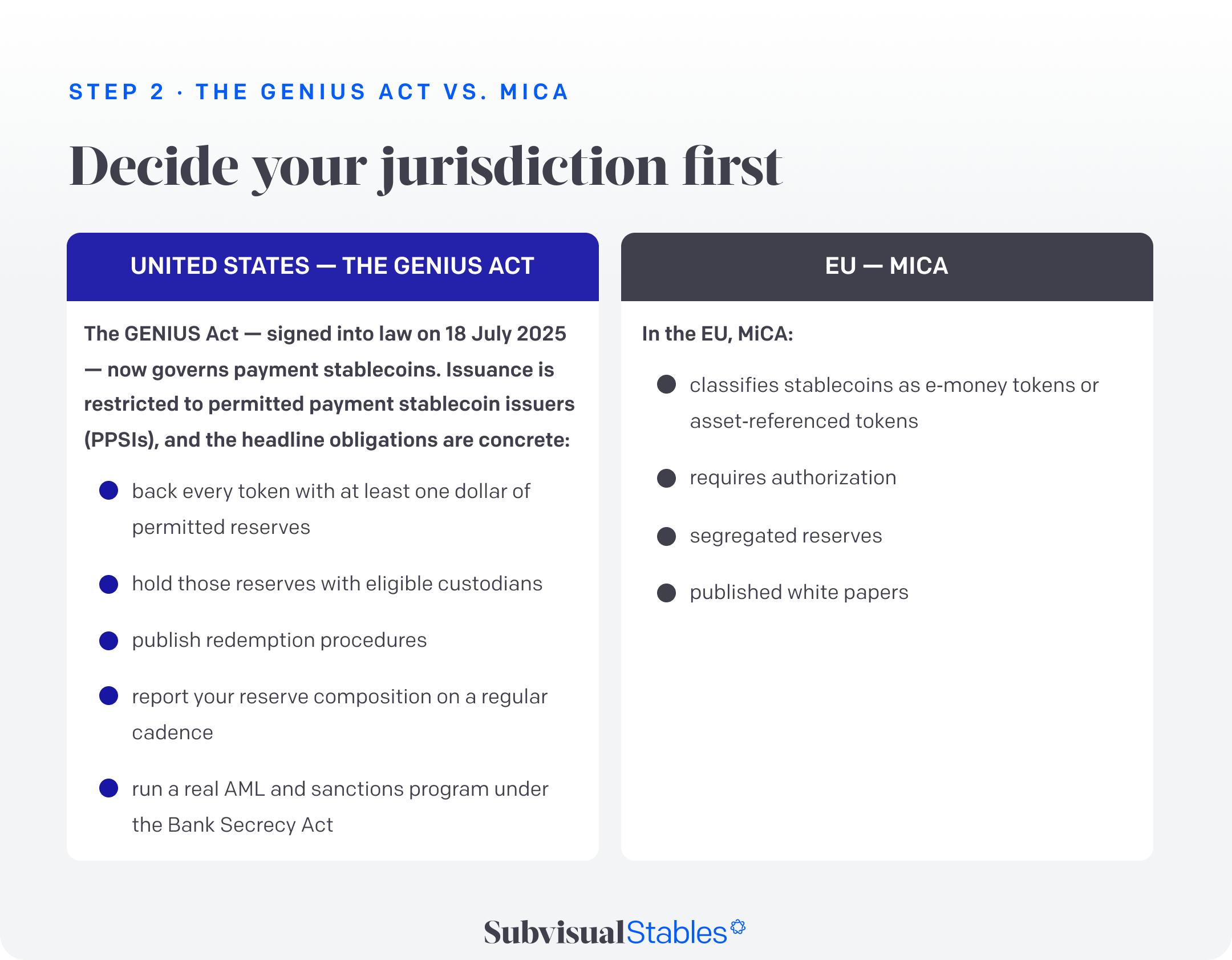
Other jurisdictions, such as Singapore, Hong Kong, or the UAE, all have their own frameworks, broadly aligned on the same principles and divergent in the details. The Playbook covers those differences; the point here is that “which rules apply” is an extremely important input to your system design. Do not treat it as an afterthought.
Step 3: Get reserves and custody right — they are the product
A stablecoin is a promise that the backing exists and that you can hand it back. Reserves and custody are where that promise is kept.
Under the GENIUS Act, reserves must be at least one-to-one and limited to a defined set of high-quality, liquid assets: coins and currency, deposits at insured banks and credit unions, short-dated Treasury bills, repos and reverse repos backed by those bills, government money market funds, and central bank reserves. You don’t get to back a payment stablecoin with corporate bonds or the token’s own governance asset. That door is closed, and for good reason.
Custody is equally prescribed. Reserves sit either directly with you or with an eligible custodian, a federally supervised institution, or a qualified state-regulated bank or credit union, and custodians can’t commingle their own funds with customer assets. Issuers with more than $50 billion in stablecoins outstanding also owe audited annual financial statements, so build the reporting in from day one rather than reconstructing it later.
Step 4: Design the smart-contract system, not "a token"
A stablecoin in 2026 is not a single ERC-20 file. It’s a governed contract system, and the token standard is the smallest part of it.
You’ll start from an established standard, usually ERC-20 on an EVM chain, for instant compatibility with wallets, exchanges, and apps, and then build the parts that actually carry the risk:
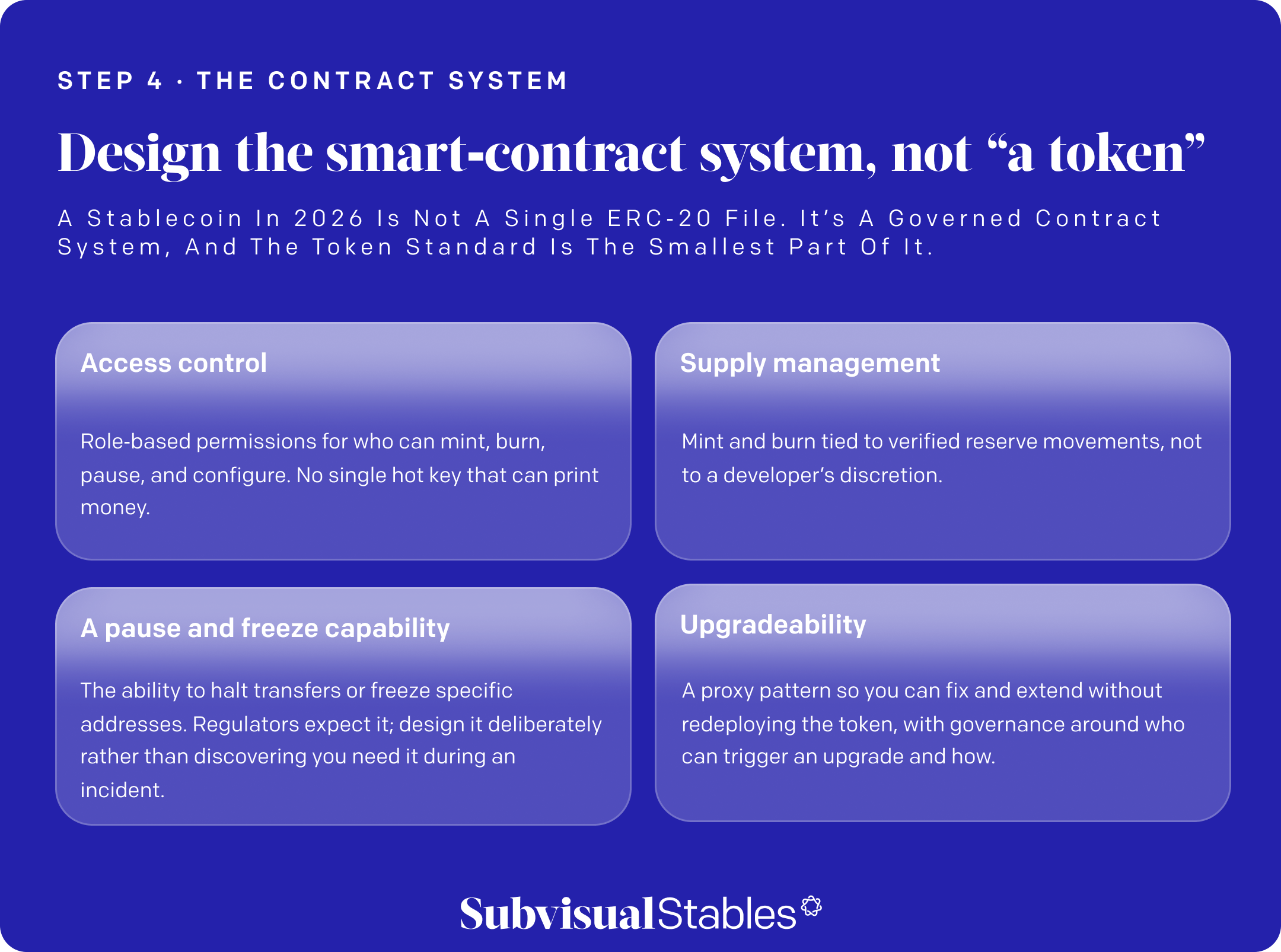
Every one of these is a place where a shortcut can become a real problem. This is the layer where “we’ll harden it later” becomes the reason for a postmortem.
Step 5: Make compliance programmable — bake it into the contracts
This is the heart of the modern approach, and the reason we keep saying compliance is an engineering constraint.
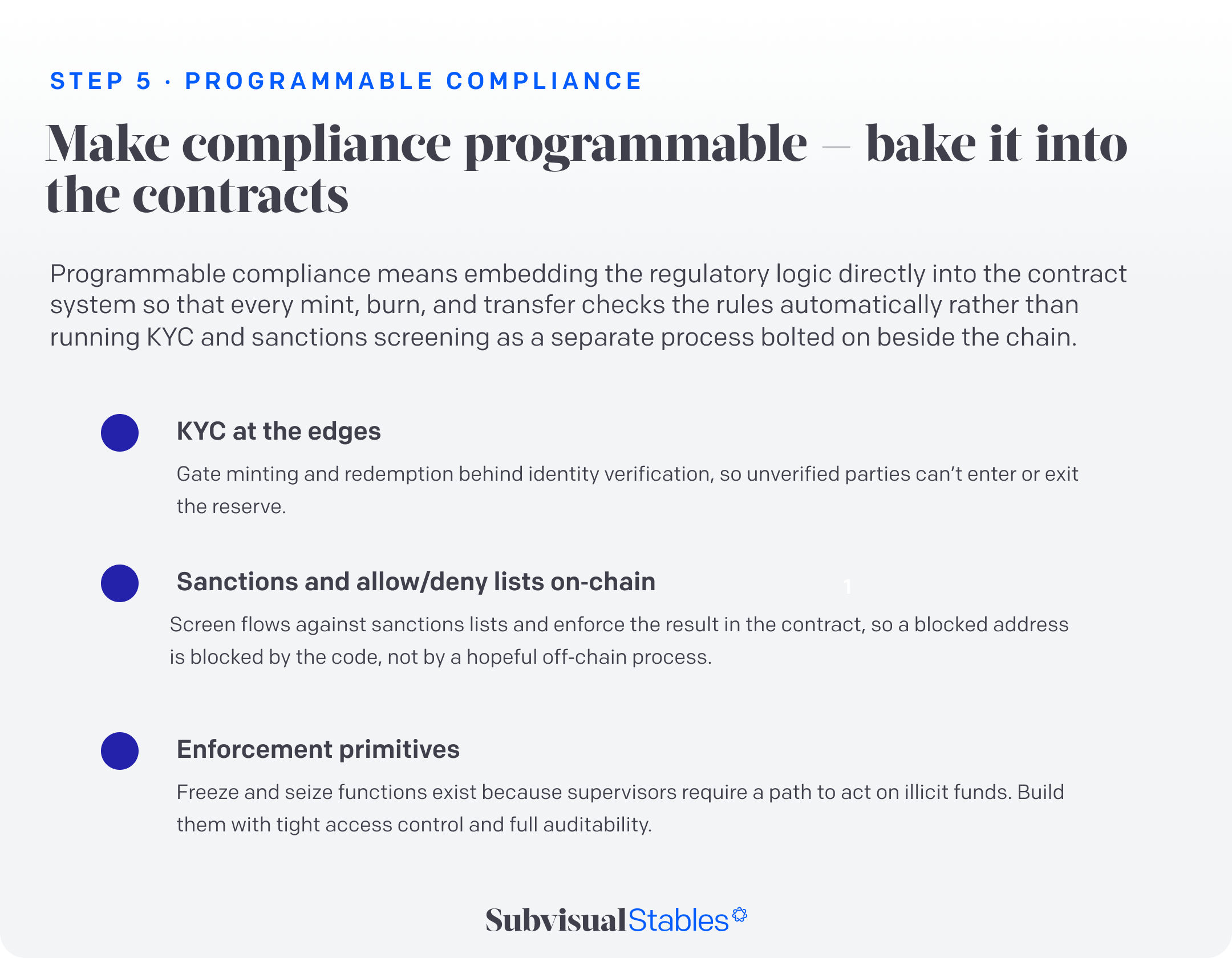
Done well, this moves compliance from reactive to proactive: the rules hold at the speed of on-chain settlement, automatically, on every transaction. Done poorly, it’s the part of the system most likely to either let bad flows through or freeze the wrong account. It deserves your best engineers.
Step 6: Wire up oracles, monitoring, and reserve attestation
Contracts can’t see the bank account. To connect on-chain supply to off-chain backing, you need decentralized oracles feeding reserve and price data into the system — and you need monitoring that watches the value of reserves against outstanding supply continuously, not once a quarter.
This is also where you meet your transparency obligations in practice. Periodic reserve reports, certified by your executives and examined by an accounting firm, are a regulatory requirement; proof-of-reserve tooling and real-time monitoring are how you produce them without heroics. Build the attestation pipeline as part of the system, because “show us the reserves, today” is a question you will be asked.
Step 7: Redemption and launch operations
Redemption is the promise the whole thing rests on: a holder can hand back a token and receive par value, within a defined window. Your redemption path, including verification, burn, reserve release, and settlement, has to be as robust and well-tested as issuance, because when confidence wobbles, that’s the path that gets stressed.
Around it sits the operational layer: wallets or APIs for minting and redeeming, treasury operations, incident response, key management, and the monitoring from Step 6. A stablecoin is not a launch-and-forget deploy.
Things to not underestimate
Since surprises are quite predictable in this business, here’s where your team’s time will end up going:
The token contract is the easy 10%. The compliance system, the reserve and attestation pipeline, the custody integration, and the operational tooling are the other 90, and you absolutely cannot cut corners.
Legal classification eats more calendar than you expect, and it gates engineering decisions, so starting it late delays everything downstream. And programmable compliance is genuinely hard to get right. We’d very much caution against treating it as a feature you’ll add in a later sprint.
None of this is meant to scare anyone off. Issuing a stablecoin is well within reach in 2026 — the frameworks are clearer than they’ve ever been — as long as you go in knowing it’s a regulated financial product wearing a smart contract, and you build it that way from the first commit.
If you’re scoping a stablecoin and want a team that’s done both the engineering and the regulatory homework, we’d be glad to help. See what we build at Subvisual, or get in touch.
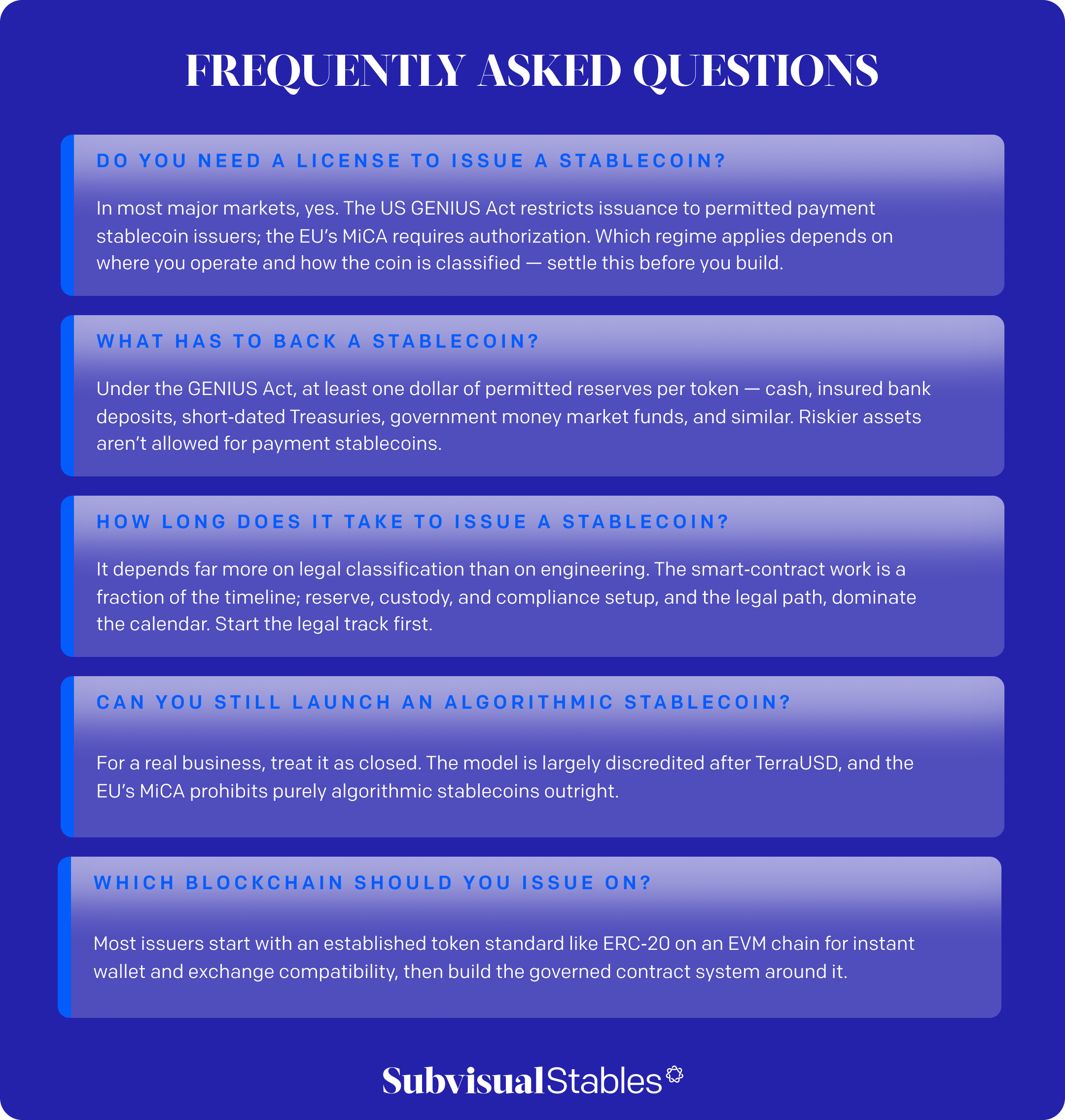
Frequently asked questions