Stablecoins, tokenised deposits and the digital euro: what’s the difference?
Written by

Chapter
- Introduction
- The four forms of euro on new rails, compared
- Euro stablecoins: e-money tokens under MiCA
- Tokenized deposits: your bank balance, on a ledger
- The digital euro: central bank money for everyone
- Pontes: central bank money on DLT, for wholesale only
- And the one that isn't a token: SEPA Instant
- What this map doesn't tell you
- Frequently asked questions
Share article
Category
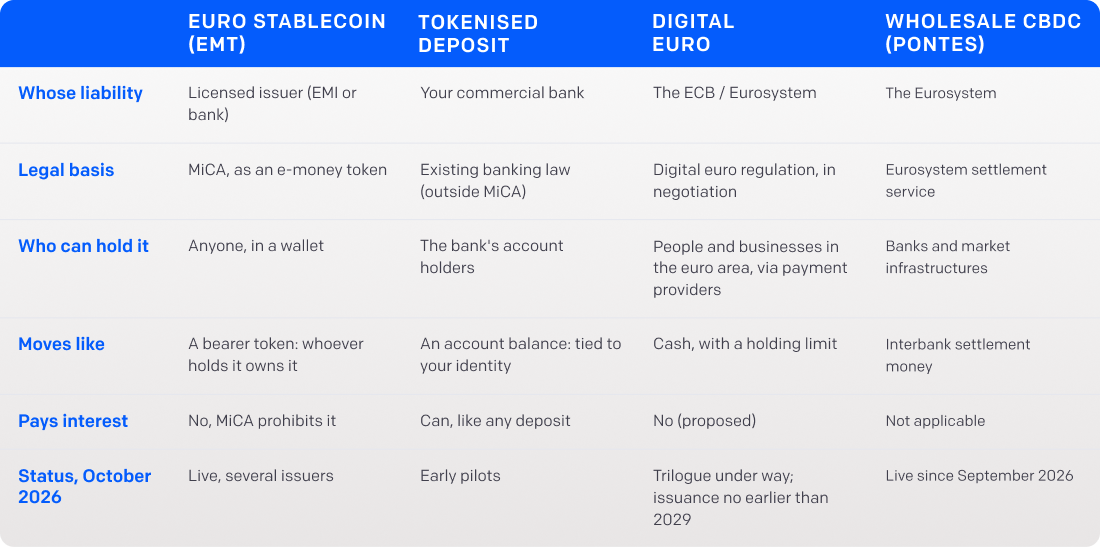
The short version: all three are euros that move on new rails. What separates them is whose promise you’re holding. A euro stablecoin (an e-money token under MiCA) is a claim on a licensed issuer that has to hold reserves and redeem at par. A tokenized deposit is an ordinary bank deposit recorded on a ledger, so it’s a claim on your bank. The digital euro would be a claim on the European Central Bank itself, like cash. A fourth form, wholesale central bank money on DLT, is for banks and market infrastructure only, and went live through the ECB’s Pontes service in September 2026.
Two years ago you could write about digital money in Europe and mean one thing. In late 2026 there are at least four forms of programmable euro either live or in negotiation. A bank consortium is preparing its own euro stablecoin. Parliament and the Council are negotiating the digital euro. And the ordinary bank transfer quietly became instant.
If you’re building payments, treasury or financial products in Europe, the differences matter more than the branding. They decide who you need a license from, whether your customers’ balances can earn interest, and what happens to the money if the issuer fails. Here’s the map.
The four forms of euro on new rails, compared
Euro stablecoins: e-money tokens under MiCA
A euro stablecoin is a token pegged one-to-one to the euro, issued by an authorized electronic money institution or credit institution, and regulated under MiCA as an e-money token (EMT). Holders have a legal right to redeem at par, at any time, and the issuer must keep reserves to cover every token in circulation.
The details are where EMTs differ from a bank balance. At least 30% of reserves must sit as deposits with credit institutions, and the rest in safe, liquid instruments. If a token becomes “significant” (more than 1 million transactions or €200 million in transaction value per day within a currency area), that minimum rises and the European Banking Authority joins the supervision. Issuers cannot pay holders interest, which is a deliberate choice: MiCA’s authors didn’t want stablecoins competing with deposits.
Because an EMT is a bearer instrument, it can move between wallets, exchanges and smart contracts without either party holding an account with the issuer. That’s what makes stablecoins useful for settlement on public chains, and also what makes regulators nervous.
Circle’s EURC was the first euro stablecoin issued under MiCA, from July 2024. Banks can issue EMTs too. Société Générale-Forge’s EURCV is one example, and in 2026 the largest bank-led effort is Qivalis, a joint venture registered in Amsterdam. It started in September 2025 with nine banks and had grown to 37 by May 2026, including ING, UniCredit, BNP Paribas, CaixaBank, ABN AMRO, Rabobank, Nordea and Intesa Sanpaolo. In September 2026 it said the token will run on public Ethereum. It’s still waiting on its EMI license from De Nederlandsche Bank and is targeting a launch before the end of 2026.
For the full regulatory requirements, see our MiCA deep dive. For the engineering side, see How to Issue a Stablecoin.
Tokenized deposits: your bank balance, on a ledger
A tokenized deposit is a regular commercial bank deposit recorded and transferred on distributed ledger technology. Legally it’s still a deposit. It sits on the bank’s balance sheet, can be covered by deposit guarantee schemes, can pay interest, and is regulated under banking law, not MiCA. MiCA explicitly excludes crypto-assets that qualify as deposits
The line between a tokenized deposit and a bank-issued EMT can look thin, so the EBA set out indicative criteria in a December 2024 report. A tokenized deposit typically comes with an ongoing contractual relationship with the customer, isn’t freely transferable on a secondary market, and can pay interest. Put simply, a deposit is tied to who you are. A stablecoin is tied to what you hold.
That difference shapes who uses them. Tokenized deposits suit banks moving money between their own clients, or between institutions that already know each other, on permissioned infrastructure. When the EBA published its report, it found only one live tokenized deposit implementation in the EEA. Most of the activity is still in pilots.
The digital euro: central bank money for everyone
The digital euro is a proposed retail central bank digital currency: a digital form of cash, issued by the Eurosystem, usable by anyone in the euro area through their bank or payment provider. Unlike a stablecoin or a deposit, it would be a direct claim on the central bank, so it carries no issuer credit risk.
Its history goes back to the same week as MiCA’s. When France and Germany pushed back on Libra in September 2019, they also asked European central banks to speed up work on a public digital currency. The ECB ran an investigation phase from 2021 to 2023 and a preparation phase from November 2023, and on 30 October 2025 its Governing Council decided to move to the next phase.
Here’s where it stands in October 2026:
- The Commission proposed the legal framework in June 2023.
- The European Parliament’s ECON committee backed it 43 to 14 on 23 June 2026, and the full Parliament voted on 9 July 2026, 416 to 169, to open negotiations with the Council.
- Trilogue rounds took place on 13 July and 10 September, with a third scheduled for 30 September. No agreement has been announced. The stated aim is a deal under the Irish Council Presidency, which ends on 31 December 2026.
- The main open issues are how payment providers get paid for distributing it, and how much each person can hold. The ECB has said a limit of around €3,000 would not threaten financial stability, but no number is final.
- If the regulation is adopted in 2026, the ECB plans a 12-month pilot from the second half of 2027 and could be ready for a first issuance in 2029.
The holding limit is the design choice to watch. A digital euro with no limit could pull deposits out of banks during a panic. A very low limit makes it a payment tool rather than a store of value. Either way, the ECB designed it not to pay interest.
Pontes: central bank money on DLT, for wholesale only
Pontes is the Eurosystem’s service for settling transactions recorded on distributed ledgers in central bank money, by linking DLT platforms to the ECB’s existing TARGET services. It’s for banks, central securities depositories and other market infrastructure, not for the public.
The ECB approved a two-track plan in July 2025. Pontes is the short-term track, and Appia is the longer-term work on an integrated European ecosystem. Pontes went live on 21 September 2026 with 14 institutions onboarded, including Deutsche Bank and Santander, and four DLT operators: Clearstream, SWIAT, Cashlink and Axiology. It runs in limited hours for now, and the ECB plans a 24/7 version by 2028.
Why it matters: when a tokenized bond changes hands, someone has to pay for it. Until Pontes, the options on a ledger were commercial bank money or a stablecoin. Now there’s a third, and it’s the safest kind of money in the system.
And the one that isn't a token: SEPA Instant
SEPA Instant is not on a blockchain, but you can’t understand any of the four above without it. Under the EU’s Instant Payments Regulation, banks in the euro area have had to receive instant euro transfers since January 2025 and send them since 9 October 2025. A transfer arrives within ten seconds, at any time of day, for no more than a standard transfer costs, and the payer’s bank must check that the payee’s name matches the account (Verification of Payee).
Electronic money institutions and payment institutions follow on a later timeline, and providers outside the euro area start in 2027.
So the baseline every token is measured against is a free, ten-second, name-checked bank transfer. What tokens can do that a bank transfer can’t, and whether that’s enough to win users, is the obvious next question. It’s also one we’re not going to answer here.
What this map doesn't tell you
A map of legal forms is only half the picture. The other half is which of these instruments people and companies actually use, in what currency and for what. That depends on liquidity, distribution, accounting habits and a dozen things no regulation decides.
That gap is the reason we’re launching FINIAM, Subvisual’s new quarterly review of European finance and on-chain markets. It will track the numbers behind this map every quarter, with every figure dated and sourced, and report each quarter what happened to the things the last issue said were coming. Issue 01 covers the first full quarter of the new European money stack, and what we found doesn’t fit neatly into the table above.
If you want the backstory first, start with From Libra to MiCA, our history of how Europe’s crypto rulebook was written.
Frequently asked questions
What is the difference between a stablecoin and a tokenized deposit?
A stablecoin is a bearer token issued by a licensed issuer, which must back it with reserves and redeem it at par. Anyone holding it owns it. A tokenized deposit is a bank deposit recorded on a ledger. It stays on the bank’s balance sheet, is linked to the account holder’s identity, can pay interest, and is regulated under banking law instead of MiCA.
Is the digital euro a stablecoin?
No. The digital euro would be issued by the Eurosystem and be a direct claim on the central bank, like cash. Euro stablecoins are issued by private companies or banks and regulated under MiCA. The digital euro is also planned to pay no interest and have a per-person holding limit.
When will the digital euro launch?
Not before 2029. The ECB has said it could be ready for a first issuance in 2029, provided the EU adopts the digital euro regulation in 2026. In October 2026 the European Parliament and Council were in trilogue negotiations, aiming to agree by the end of the year. A 12-month pilot is planned from the second half of 2027.
What will the digital euro holding limit be?
It hasn’t been decided. The holding limit is one of the main open issues in the trilogue negotiations. ECB analysis has suggested that a limit of around €3,000 per person would not endanger financial stability, but no final figure has been agreed.
Can euro stablecoins pay interest?
No. MiCA prohibits issuers of e-money tokens, and crypto-asset service providers, from granting interest to holders. That’s one of the main legal differences between a euro stablecoin and a tokenized bank deposit, which can pay interest like any other deposit.
What is Pontes?
Pontes is a Eurosystem service, live since 21 September 2026, that lets transactions on distributed ledger platforms settle in central bank money by connecting those platforms to the ECB’s TARGET services. It’s for banks and market infrastructure, and it’s the short-term track of the ECB’s plan for wholesale DLT settlement. The longer-term track is called Appia.
What is Qivalis?
Qivalis is a joint venture of European banks, based in Amsterdam, preparing to issue a euro stablecoin regulated as an e-money token under MiCA. It has 37 member banks, plans to issue on public Ethereum, and is waiting on an electronic money institution license from De Nederlandsche Bank ahead of a launch targeted for late 2026.
Choosing between these rails for a real product? We’ve built stablecoin infrastructure from scratch and run Stables for teams that need settlement, reconciliation and compliance handled. Let’s talk.