There are no recipes for startup success: a few notes on how the marketing is being reshaped
Written by

Chapter
Share article
Category
Recently, someone sent me this article called We Have Learned Nothing. I’ve been thinking about starting this Substack for a little while now, and this kind of thing is exactly why. I found it quite interesting and I’d like to add my two cents.
The article’s argument is quite simple: everyone that says they know how to make startups work is wrong, the pundits that published such bestsellers as The Four Steps to the Epiphany or The Lean Startup are not only wrong, but they aren’t interested in being right. Their business model is selling advice, not making companies thrive, and that’s working out just fine.
Now, there are two sides to this story, one that I fully agree with (the Red Queen hypothesis is correct. If you do what everyone else does, you get what everyone else gets, so arguably there can never be a definitive formula) and one that I don’t (we have learned nothing).
But first, a little disclaimer:
I was never a pundit, but I was wrong
Subvisual is a product and venture studio, and a lot of our work is with startups. When we were getting started ourselves, over a decade ago, the kinds of books mentioned above (those books specifically, to be quite honest) were a big part of what we thought was our job.
We wanted to develop a tried and true method for growing startups. We thought we could help pretty much anyone that had a good idea and enough talent to make it. We couldn’t ensure anything, of course, but we genuinely thought we could help.
We were, of course, wrong. The reason we were wrong is correctly identified by the article I shared at the beginning of this text. The Red Queen hypothesis holds a lot of water.
The Red Queen hypothesis is an idea borrowed from evolutionary biology that’s been making the rounds for quite a while, and it’s relatively simple to explain thanks to the quote I provided above. It argues that extinction of a species (or a startup) can’t solely be predicted by what it does, but by what everyone else is doing as well. You need to keep adapting/evolving just to stay in the same place (in this case survive), because if someone else finds a better fit quicker than you, their action will deteriorate your fitness.
This is not great if you’re trying to find a “science of startups” that can work predictably for everyone, because an advantage is only ever an advantage if you’re the only one doing it.
The article, alas, is still wrong
The article’s underlying theme is that we have learned nothing in the last decade because we haven’t gotten better at getting startups funded and successful.
But here’s the thing: that’s not what we’re trying to do.
Once you accept that the Red Queen hypothesis is true, or at least that it holds some truth to it, you would be silly to try and make more startups last longer. A key aspect of the Red Queen hypothesis is that speciation positively correlates with extinction rates. This means that the success of any species makes life harder for all the others.
This may feel a little cruel, but it’s a feature, not a bug.
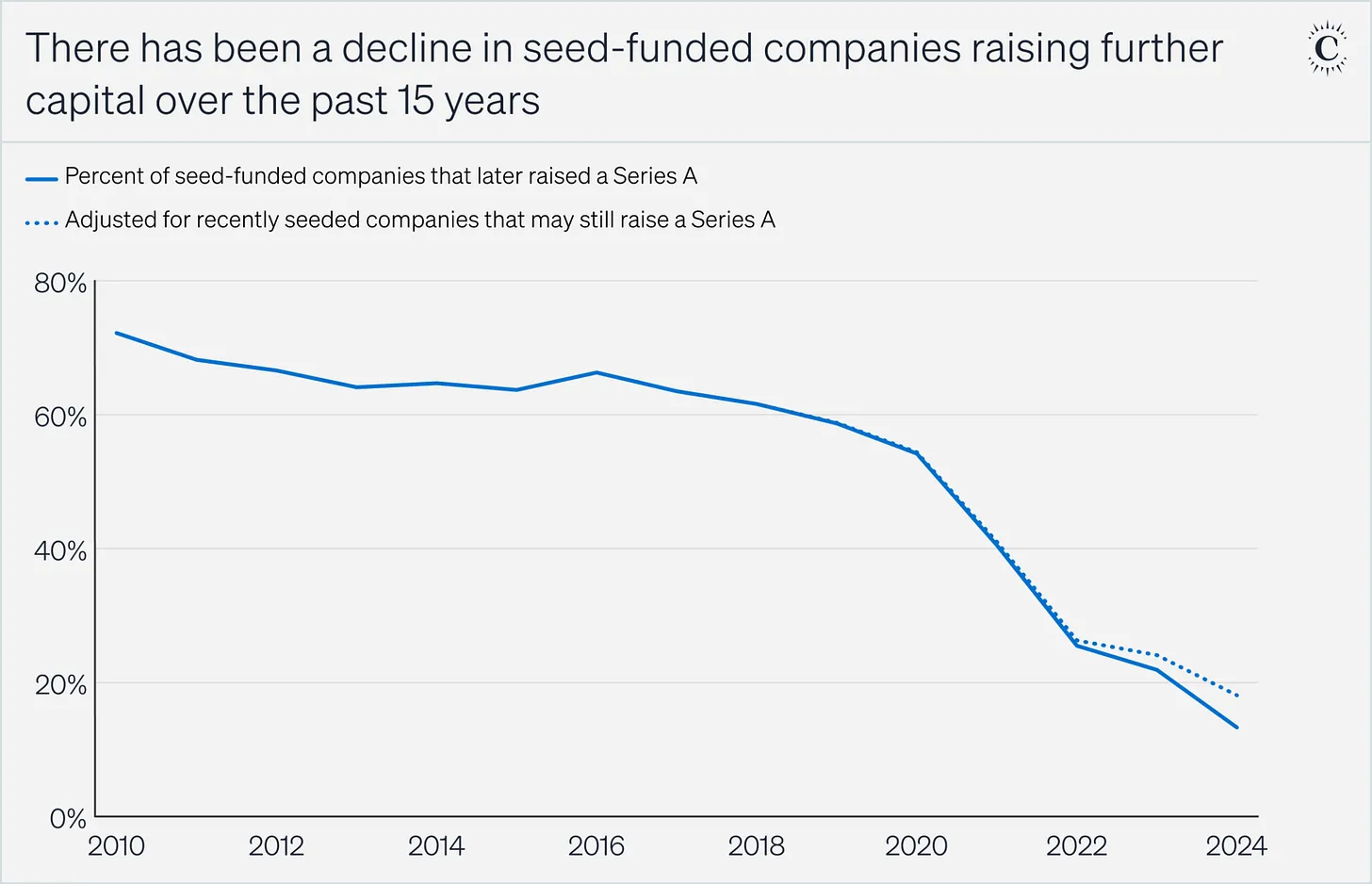
This graph is shared in We Have Learned Nothing followed by this statement: “The precipitous drop in seed-funded companies raising further capital does not support the idea that venture-backed startups have become more successful over the past 15 years. If anything, they seem to fail more often.”
And this is where I disagree with the article. I think this shows we have learned quite a bit. It shows we have learned how to stop throwing good money after bad. It shows we have learned that the operative word in “sunk cost fallacy” is “fallacy”.
You can’t sistematize success, what you can do is make decisions
All the things we learned from the much maligned punditry books were not wasted. Learning is never wasted. The Build-Measure-Learn Loop, Customer Development, the concept of an MVP, these things were framed as growth frameworks, but I’d rather think of them as invalidation frameworks. We have become much better at early-stage filtering and seed stages have become make-or-break.
Again, this is a feature, not a bug. No one needs more zombie insolvencies. If we kept failure rates remarkably stable (as the graphic below indicates) and we are funding much fewer companies at a Series A level (see above), then I’d argue we have learned quite a bit.
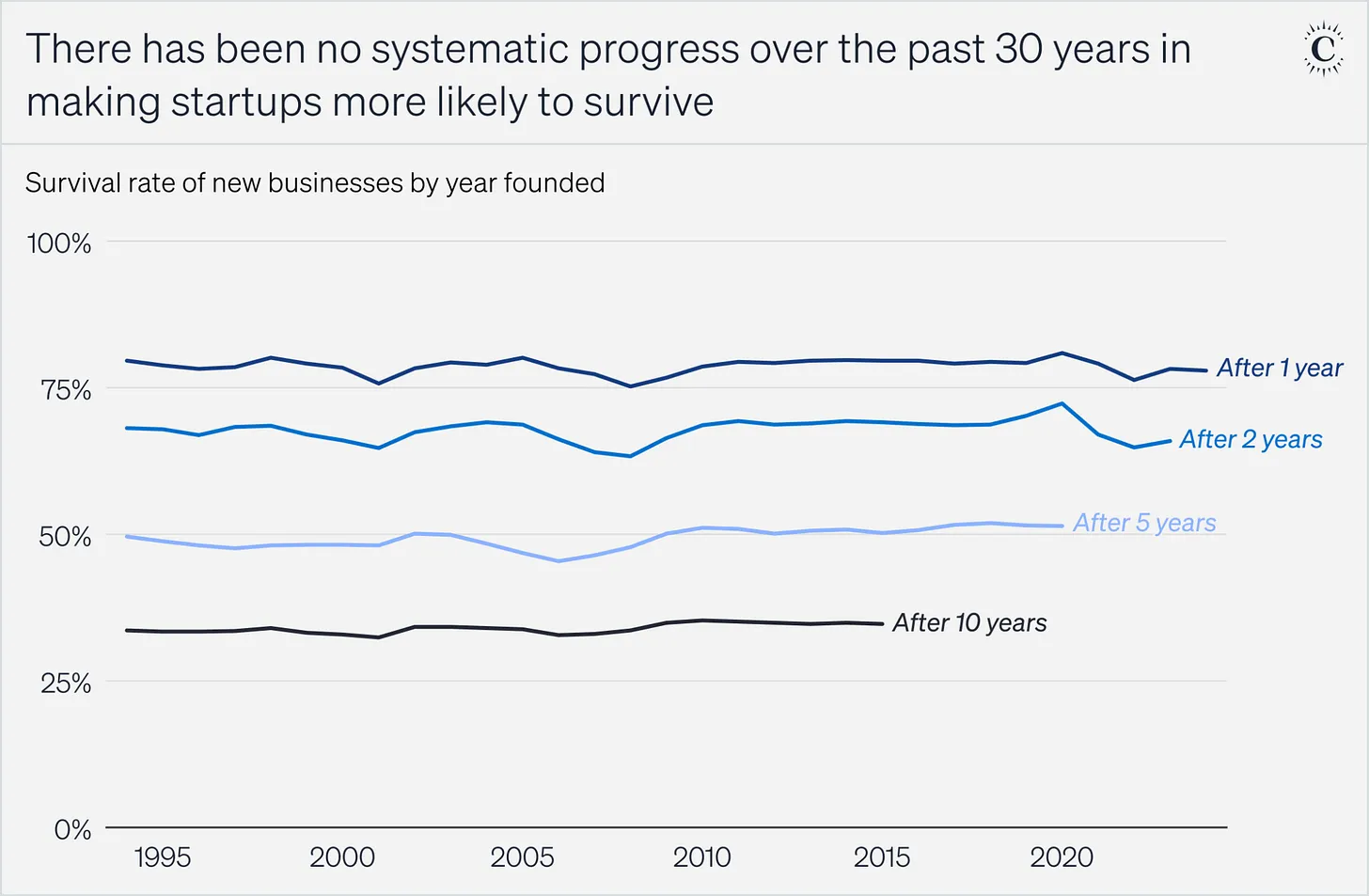
Here’s another quote straight from the article: “The system may be generating more jackpots, but it is not improving the individual entrepreneur’s odds.”
The system was never meant to “improve the individual entrepreneur’s odds”. It was meant to put resources in the hands of those entrepreneurs that were more likely to generate jackpots.
And this is where Subvisual has become decisive.
We have learned over the years how best to identify both the startups that can make it and how to make the decisions that are needed to keep companies running in the right direction. This is why we take on so few ventures and why we have the record we do.
A significant part of this is understanding that the key isn’t in figuring out the answers, it’s in figuring out which questions need to be asked. These are different for every company, for every market.
Let me quote from Wikipedia, because I really like this explanation of Van Valen’s Law. Highlights in bold are mine:
“(…) the probability of extinction does not depend on the lifetime of the species or higher-rank taxon, instead being constant over millions of years for any given taxon. However, the probability of extinction is strongly related to adaptive zones, because different taxa have different probabilities of extinction. In other words, extinction of a species occurs randomly with respect to age, but nonrandomly with respect to ecology.”
If you want a startup to survive, what you need to figure out isn’t what it is. It’s what you’re adapting into. That’s different every time.
And then you need to run.
*This article was originally published published on Substack. To read the full piece and subscribe, please go to https://rmdmac.substack.com/